+86 186 9588 1207 Mobile Phone
8618695881207 Whatsapp
+86 186 9588 1207 Wechat

info@biohuaer.com E-mail
+86 186 9588 1207 Mobile Phone
8618695881207 Whatsapp
+86 186 9588 1207 Wechat
info@biohuaer.com E-mail

For years, most hair and scalp serums have followed the same basic format: a bottle, a dropper, and a formula built around ingredients such as peptides, botanical extracts, caffeine, or conditioning actives.
That format still works well for many products. However, for hair care brands trying to stand out in an increasingly crowded market, changing the ingredient list alone may no longer be enough.
Consumers are also paying attention to how a product is applied, how the routine feels, and whether the format offers something visibly different from a conventional serum.
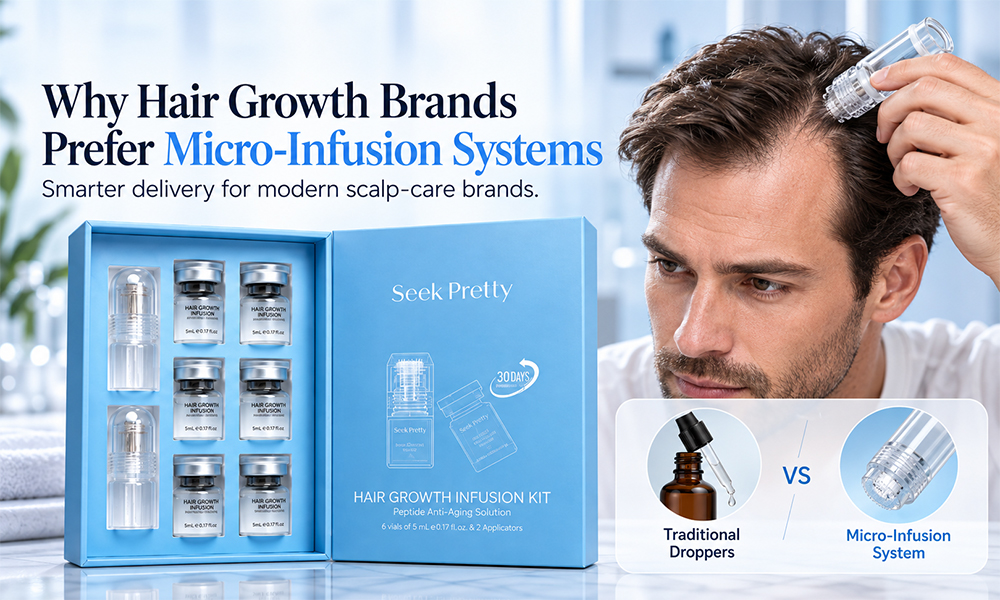
That is one reason more brands are exploring the micro infusion hair growth system—a product format that combines a scalp serum with a micro-infusion applicator rather than relying only on a traditional dropper.
The change is not simply about replacing one bottle with another. It reflects a broader shift toward combining formulation, delivery format, user experience, and packaging into one complete scalp-care system.
For private label and OEM buyers, that opens up new opportunities for product differentiation.
Traditional dropper serums remain one of the most familiar formats in scalp and hair care. They are simple to manufacture, easy to understand, and suitable for many types of formulas.
However, from a branding perspective, the category has become highly competitive.
Many scalp serums are built around familiar ingredient concepts such as:
Peptides
Botanical extracts
Amino acids
Caffeine
Conditioning agents
Moisturizing ingredients
Vitamins and supporting actives
The specific formula may differ between brands, but the overall product story can start to look similar.
A consumer comparing several scalp serums may see different packaging, but the basic routine is often the same:
Open the bottle → apply drops → massage into the scalp.
For established brands, ingredient differentiation may still be enough. For newer brands, private label companies, and e-commerce sellers, however, the application format itself can become another point of differentiation.
Brands can improve the appearance of a traditional serum through:
Premium glass bottles
Custom droppers
Metallic caps
Embossed cartons
Custom colors
Premium secondary packaging
These elements improve perceived value, but they do not fundamentally change how the consumer interacts with the product.
A micro-infusion system gives brands another layer of differentiation because the application tool becomes part of the product itself.
Instead of selling only a serum, the brand can sell a more complete scalp-care routine.
A micro infusion hair growth system generally combines two core elements:
A scalp serum
A micro-infusion applicator or microneedling-style stamp
Rather than dispensing the serum through a conventional dropper, the system uses a specialized applicator during the scalp-care process.
The basic concept can be understood as:
Serum reservoir → Micro-infusion applicator → Controlled scalp contact → Serum application during use
This makes the product different from a standalone serum.
From a brand-development perspective, the important point is that the formula and applicator must be considered together.
Serum viscosity, dispensing performance, applicator structure, packaging configuration, and the intended application routine all affect the final user experience.
That is why a micro-infusion product is better viewed as a complete system rather than simply another serum.
The difference between the two formats is not simply the ingredient list. It is largely about the delivery experience and product architecture.
| Feature | Traditional Dropper Serum | Micro Infusion System |
|---|---|---|
| Application Method | Manual drop application | Device-assisted application |
| Product Format | Serum only | Serum + applicator |
| User Experience | Familiar and simple | More interactive and differentiated |
| Scalp Contact | Surface application | Controlled micro-contact during use |
| Brand Differentiation | Often formula-driven | Formula + device + packaging |
| Kit Potential | Usually one main product | Multi-component system |
| Private Label Options | Formula, bottle, carton | Formula, applicator, kit, packaging |
| Visual Demonstration | Limited | Stronger for video and social content |
It is important not to oversimplify this comparison.
Traditional scalp serums are not automatically inferior, and micro infusion does not replace the need for a well-designed formula.
Instead, the micro-infusion format gives brands another way to create a more distinctive product experience.
A conventional product may be positioned simply as:
Hair Growth Serum
A micro-infusion product can instead be positioned as:
Micro Infusion Hair Growth System
That change may appear small, but commercially it can be significant.
The second format gives the brand more elements to communicate:
Serum formulation
Applicator technology
Application routine
Refill concept
Kit configuration
Packaging system
Scalp-care positioning
Instead of competing only on ingredients, the brand can compete on the entire product experience.
A traditional dropper serum is usually sold as one bottle.
A micro-infusion system may include:
Serum ampoules or bottles
Micro-infusion stamp or applicator
Replacement heads
Storage tray
User instructions
Premium retail packaging
That allows the product to be positioned as a more complete system rather than a single cosmetic item.
For brands, this can create opportunities for:
Premium positioning
Gift sets
Starter kits
Refill programs
Multi-month kits
Subscription models
Salon or professional retail kits
The commercial advantage is not that every micro-infusion system must be more expensive.
The advantage is that the brand has more flexibility when designing its product and price architecture.
Hair and scalp products are increasingly promoted through visual platforms.
A traditional dropper is relatively simple to demonstrate:
Drop serum → massage scalp.
A micro-infusion device creates a more recognizable application process.
That can make it easier for brands to produce content for:
TikTok
Instagram Reels
YouTube Shorts
Influencer demonstrations
Product tutorials
E-commerce product videos
The applicator itself gives the consumer something visible to understand.
For brands that rely heavily on social advertising or influencer marketing, product demonstration can become an important part of differentiation.
One of the most useful advantages of a system format is that it can support a broader product line.
A brand may begin with one scalp-care system and later expand into related concepts such as:
Scalp nourishment systems
Anti-thinning cosmetic serums
Moisturizing scalp care
Beard care systems
Scalp conditioning products
Post-treatment scalp care
Refill serums
Replacement applicators
Multi-step hair care kits
This allows a company to build a category rather than relying on one standalone SKU.
This is one of the most important points when developing a micro-infusion hair product.
A more advanced applicator does not make formulation quality less important.
In fact, device-assisted products require even more attention to formula compatibility.
A successful system depends on both:
Good formulation + suitable delivery format
The serum must be compatible with the dispensing structure of the applicator.
If the formula is too thick, dispensing may become inconsistent. If it is too thin, leakage or uncontrolled flow may occur.
The appropriate viscosity therefore depends partly on the final applicator design.
Not every ingredient combination is automatically suitable for every delivery system.
During product development, brands should evaluate:
Ingredient solubility
Formula stability
Preservative system
pH
Texture
Scalp feel
Packaging compatibility
The final formula should be designed for the complete product rather than selected independently from the device.
A scalp serum may perform well in a standard bottle but behave differently when packaged with another dispensing format.
Brands should therefore evaluate issues such as:
Long-term stability
Temperature stability
Packaging interaction
Leakage
Sedimentation
Discoloration
Odor changes
These factors are especially important for private label products intended for international distribution.
Choosing a supplier for this type of product is different from sourcing a conventional bottle of serum.
Brands should evaluate both cosmetic formulation capabilities and system integration capabilities.
A suitable supplier should be able to provide more than one standard formula.
Depending on the brand concept, buyers may need:
Existing mature formulas
Customized formulations
Customized active ingredient concepts
Texture adjustment
Viscosity adjustment
Fragrance customization
Scalp-care positioning
Huaer supports formula, ingredient, scent, bottle, capacity, packaging, and design customization for private-label projects.
Brands can learn more about the current Private Label Micro Infusion Hair Growth System .
This is one of the most overlooked areas in product development.
A company sourcing the serum from one supplier and the applicator from another may need to manage compatibility testing independently.
When the product is developed as one complete system, several factors can be evaluated together:
Serum flow
Applicator dispensing
Leakage performance
Package sealing
User handling
Component fit
Filling process
For B2B buyers, system compatibility can be more important than choosing individual components based only on price.
Different brands may want different kit structures.
A starter kit may contain fewer serum units, while a premium or subscription kit may contain more.
Depending on the project, kit configurations may include:
2 serum units + 2 applicators
3 serum units + 1 applicator
3 serum units + 3 applicators
Customized quantities and capacities
Flexible configuration gives buyers more freedom when planning:
Retail pricing
Starter kits
Refill strategies
Subscription models
Premium bundles
For micro-infusion products, packaging is part of the product architecture.
Customization may include:
Serum bottle
Ampoule format
Applicator
Inner tray
Retail carton
Label
Instruction card
Color scheme
Logo
Capacity
Kit quantity
For brands that want a differentiated retail product, this is usually more valuable than simply adding a logo to stock packaging.
The supplier should also be evaluated from a manufacturing perspective.
Important areas may include:
Production environment
Quality management system
R&D capability
Automated production capacity
Batch consistency
Packaging coordination
Export documentation support
Huaer provides OEM and ODM support for brands developing customized cosmetic and micro-infusion products.
Regulatory documentation should always be evaluated according to the target market, final formula, product classification, and packaging configuration.
The first question is not which bottle to use.
The first question is:
What type of product does the brand want to build?
Possible directions may include:
Premium scalp care
Hair-strengthening cosmetic care
Anti-thinning positioning
Scalp nourishment
Salon retail
E-commerce kits
Subscription scalp-care systems
The brand can choose an existing formulation or develop a customized one.
Possible customization areas include:
Key active ingredients
Supporting ingredients
Texture
Viscosity
Fragrance
Color
Product positioning
At this stage, the formula should also be evaluated for compatibility with the selected micro-infusion applicator.
Different applicator structures can create different user experiences.
Important considerations may include:
Applicator design
Disposable component format
Serum reservoir size
Needle configuration
Flow characteristics
Packaging method
Intended usage routine
The applicator should be selected as part of the complete product rather than treated as an unrelated accessory.
A brand may choose a simple starter system or a larger multi-use kit.
Example configurations may include:
Starter Kit: one applicator with limited serum units
Standard Retail Kit: multiple serum units with applicator and accessories
Extended Care Kit: larger serum quantity, additional applicator components, and premium packaging
Once the formula and device are confirmed, the packaging system can be designed around them.
Outer carton
Inner tray
Bottle or ampoule layout
Brand colors
Product instructions
Logo
Product name
Market-specific labeling
For a system-based product, the packaging should help the consumer immediately understand how the components work together.
Sampling should not focus only on the serum.
The brand should evaluate the complete kit, including:
Does the serum dispense properly?
Does the applicator leak?
Is the viscosity suitable?
Is the packaging secure?
Are the components easy to remove and use?
Does the kit feel premium?
Are the instructions clear?
Testing the final system reduces the risk of discovering compatibility issues only after mass production begins.
After confirming the formulation, applicator, capacity, packaging, artwork, labeling, and sample performance, the project can move into mass production.
For private label buyers, this integrated approach is generally more efficient than coordinating separate serum, device, packaging, and filling suppliers.
Huaer develops private-label micro-infusion systems for brands looking to combine customized scalp-care formulations with dedicated applicators and retail packaging.
Depending on the project, customization can include:
Scalp serum formula
Active ingredient concept
Serum viscosity
Kit quantity
Applicator configuration
Bottle or ampoule size
Packaging material
Label design
Retail box design
Private branding
This allows brands to develop a product around their own market positioning instead of simply reselling a standard serum.
Explore the current Hair Growth Serum with Microneedling Stamp Micro Infusion System for more information about available private label and customization options.
This product format can be especially relevant for:
Hair Care Brands: brands looking for a more differentiated scalp-care product
Private Label Companies: businesses building proprietary products under their own brand
E-Commerce Brands: companies that depend heavily on visually demonstrable products
Salon Brands: companies selling scalp-care products through salons or professional beauty channels
Beauty Distributors: distributors looking for new formats beyond conventional bottled serums
Startups: new brands that want to enter the scalp-care category with a stronger product story
There is no universal answer.
The right format depends on your product strategy.
A traditional serum may be the better choice when:
A lower entry price is important
Simplicity is a priority
The formula itself is highly differentiated
The brand already has strong consumer recognition
The target customer prefers a simple daily routine
A micro-infusion system may be more suitable when:
Product differentiation is a priority
You want to build a premium kit
Your marketing relies heavily on product demonstration
You want a multi-component product system
You plan to introduce refill products
Private label customization is important
You want the application method to become part of the brand story
The decision should therefore be based on the brand's target market, price range, sales channel, and product positioning, rather than simply on which format appears newer.
Hair care brands are not necessarily moving away from traditional droppers because conventional serums have become obsolete.
The bigger change is that brands are looking beyond ingredients alone.
As the scalp-care market becomes more competitive, delivery format, user experience, packaging, and product architecture are becoming additional ways to differentiate a product.
A micro infusion hair growth system allows brands to combine:
Formula + Applicator + Packaging + Routine
into one integrated product concept.
For private label buyers, that creates more room to customize the product and build a stronger commercial identity.
If you are developing a new scalp-care line and want to move beyond a conventional dropper serum, Huaer can support private-label development from formula selection and customization to micro-infusion applicators, kit configuration, packaging, and production.
Explore Huaer's Private Label Micro Infusion Hair Growth System
 Add to Inquiry Successfully!